
Reviewed · GALATA TOWER GUIDED TOURS
Hidden Gems of the Istanbul: From Galata Tower to Balat
Ferries, churches, and staircases in one loop. I like how this route pairs SALT Galata with street-level viewpoints, so you get both city culture and real neighborhood texture. You also spend real time on the water, with a ferry hop that turns the Golden Horn into part of the sightseeing.
I like the pacing too, with short, focused stops that make sense even when you are tired of museum lines. You get a professional English-speaking guide, mobile ticket access, and group discounts, plus small comforts like free drinks and dessert along the way.
One drawback to plan for up front: Galata Tower entry is not included in the price, so budget a separate ticket for the tower visit.
In This Review
- Key things to know
- Why Galata to Balat works as a half-day story
- Price and what you actually get for $105
- Start at Tünel, then Galata Tower and Istanbul’s skyline watchtower
- Kamondo Stairs: the art-nouveau side of Galata
- SALT Galata: culture, archives, and an Ottoman Bank Museum connection
- Karaköy rihtim ferry ride: the Golden Horn from both sides
- Patriarchate of Constantinople: a reflective stop with built-in respect
- Balat colored stairs and colorful streets you can actually navigate
- Colorful houses and the story of fire, masonry, and compact living
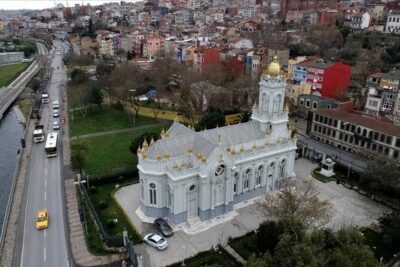
- Saint Stephen’s Bulgarian Orthodox Church, also known as the Iron Church
- Watching Istanbul from the Golden Horn estuary
- Egyptian Bazaar ending: dessert tasting and a classic market finish
- Who this tour suits best, and when to skip it
- Should you book this Galata to Balat route?
- FAQ
- Is the Galata Tower admission ticket included?
- How long is the tour?
- What language is the tour offered in?
- Is transportation included?
- Is dessert included?
- Where does the tour start and end?
Key things to know

- Galata Tower is the only stop where your ticket cost is separate from the tour price
- SALT Galata adds an evidence-based cultural break, including exhibition space and Ottoman Bank Museum Collection material
- Golden Horn ferry ride gives you European and Anatolian side views without forcing extra walking
- Balat streets are UNESCO-protected, and the architecture tells a story of fires, masonry rebuilds, and compact home layouts
- Church donations are included, which helps you visit with a sense of purpose, not just sightseeing
- Free Turkish dessert and drinks at the Egyptian Bazaar makes the ending feel like a payoff
Why Galata to Balat works as a half-day story
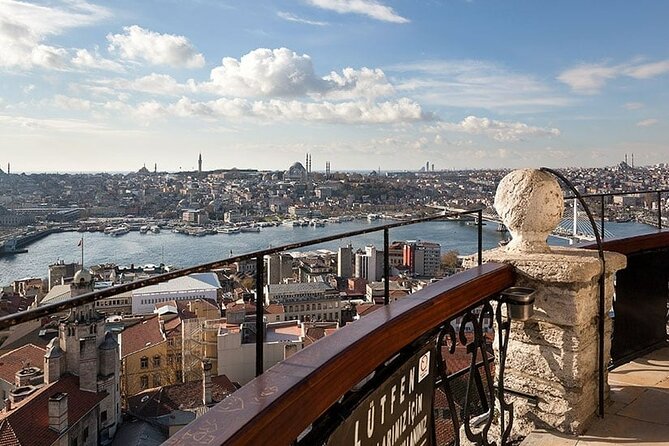
If your time in Istanbul is limited, this plan is smart. It strings together landmarks from Beyoğlu and Karaköy, then shifts into Balat, where you slow down and read the city through architecture and place names.
The best part is that you do not just “see.” You connect the dots. Galata Tower anchors the skyline. SALT Galata adds the institution angle. Balat puts faces, religions, and street design into the picture. Even the ferry is used as a viewpoint tool, not just transport.
You also get a built-in rhythm: some stops are quick photo-and-look moments, while others are long enough to step back and actually understand what you are standing in front of. That makes a big difference when you travel with limited energy.
Panoramic views over the Golden Horn
- Istanbul: Galata Tower All-Day Entry Ticket with Audio Guide
★ 4.4 · 1,190 reviews - Istanbul: Galata Tower Entry Ticket with Audio Guide
★ 4.3 · 474 reviews - Istanbul City Walk: Galata Tower, Istiklal Street & Karaköy
★ 4.7 · 97 reviews
Price and what you actually get for $105
At $105 per person for roughly 4 to 6 hours, the value comes from what is handled for you. You are paying for a guide, coordinated route timing, and transportation by ferry, plus included admission tickets at most stops.
Here is the practical breakdown:
- Included: professional English-speaking guide, mobile ticket, ferry transport
- Included: admission tickets for every listed site except Galata Tower
- Included: free tasting for drinks and dessert
- Included: donations for churches
So the “real” cost picture depends on Galata Tower. Since its entry ticket is not included, you should expect to add that on top. Still, for a multi-site route across two districts, the included admissions and ferry make the price feel grounded rather than inflated.
Start at Tünel, then Galata Tower and Istanbul’s skyline watchtower
You start near Tünel Meydanı, then head straight to Galata Tower for a proper first anchor. This is the moment where Istanbul starts to make sense visually.
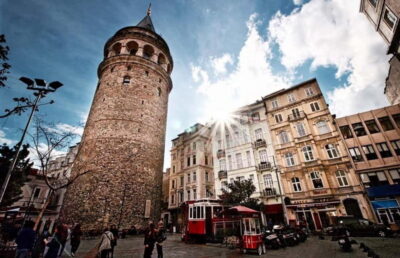
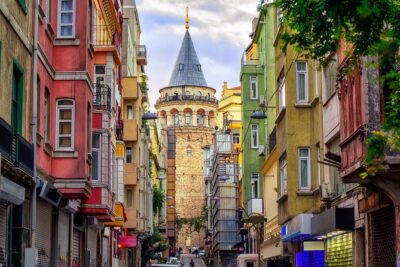
Galata Tower is considered among the oldest towers in the world and a signature silhouette element. It was used as a long-term fire watchtower, and it was named Galata Fire Tower. That detail matters because it changes how you view the structure. You are not only looking at a pretty skyline prop, you are looking at an old city safety system.
The tour allocates about 45 minutes at the tower, but you need to remember entry is not included. If you are traveling in peak season, plan for the fact that tickets will be one more step you handle separately.
Tip for your visit: use the time to orient yourself. Ask your guide to explain what you are seeing from the tower area, not just to point out buildings. Views are easier when you understand how the city is arranged.
Kamondo Stairs: the art-nouveau side of Galata
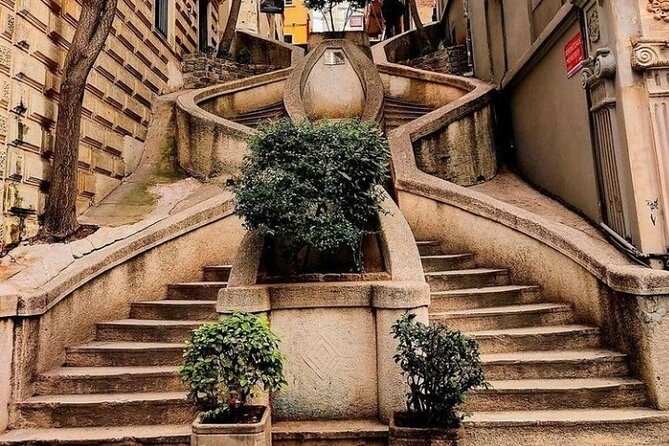
Right after the big skyline moment, you get something smaller but satisfying: Kamondo Stairs in the Galata district.
These are Art Nouveau-style stairs completed in the 1850s, built by the House of Camondo. This stop works because it teaches you how to spot style transitions in Istanbul. One footnote of Europe in the middle of centuries of Ottoman-era street patterns.
You only have about 15 minutes here, so keep your expectations right. This is a look-and-learn moment, not a long stroll. If you are the kind of traveler who likes corners, craftsmanship, and details, you will appreciate the short duration.
SALT Galata: culture, archives, and an Ottoman Bank Museum connection
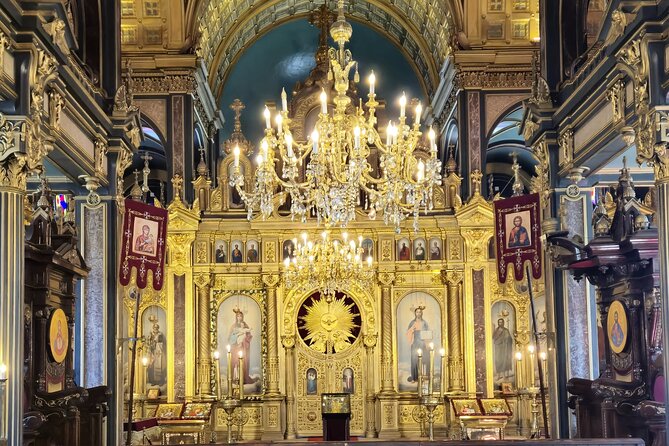
Then you shift indoors at SALT Galata. This stop is a smart breather because it is not just “gallery time.” It is institutional, with spaces for research and exhibitions.
SALT Galata houses:
- the Salt Research Gregory Michael Kiez Hall, a specialized library
- the Salt Research Ferit F. Şahenk Hall, with researcher use upon registration
- an auditorium for talks and conferences
- exhibition and event spaces
- a permanent exhibition about SALT’s 145-year history, using documents from the Ottoman Bank Museum Collection
The value here is how it adds structure to what you see outside. When you are walking between districts like Galata and Balat, your brain can feel like it is collecting random scenes. SALT gives you a framework and context, especially through the Ottoman Bank Museum Collection materials.
You get about 20 minutes at SALT Galata. That is enough time to orient and catch the highlights without turning the day into a long museum commitment. If you tend to read every label, you might move a bit slower, so use your guide’s cues on what is most useful.
Lesser-known corners past the postcard sights
- Circle Istanbul (Extraordinary Istanbul)
- Istanbul Grand Bazaar: From Rooftops to the Secret Passages
- Istanbul City and Hidden Gem Private Guided Tour 1, 2, 3 Day opt.
- Highlights & Hidden Gems With Locals: Best of Istanbul Private Tour
- Istanbul Off the Beaten Path Tour with Guide, Lunch and Transfers
- Istanbul Modern City Walking: Taksim to Galata With Secret Passages
Karaköy rihtim ferry ride: the Golden Horn from both sides
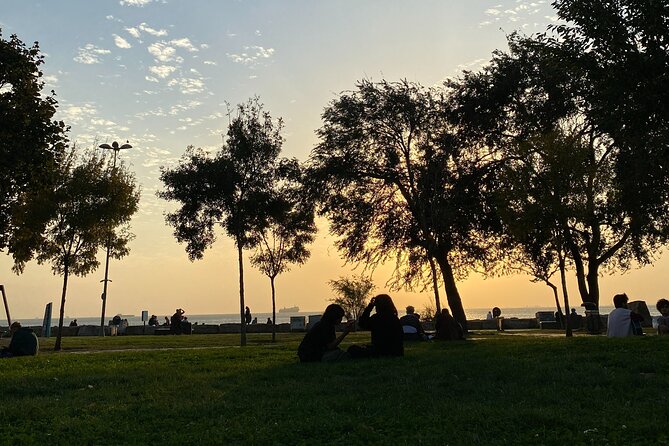
Next comes one of the best “moving breaks” in Istanbul: Karaköy Rihtim, where you take a ferry.
The route uses the ferry strategically. You spend around 20 minutes on the water, and the payoff is the view. You can watch the European and Anatolian sides of Istanbul from the estuary. That gives you a sense of the city’s scale that you simply cannot get from looking at one shore.
Also, ferry time helps the day feel less grindy. On a walking-heavy itinerary, that kind of break is not a luxury. It is part of how you enjoy the city.
Quick practical thought: take out your phone or camera before boarding, then give yourself permission to watch with your eyes too. This is one of those views where photos are easy, but understanding what you are photographing is even better.
Patriarchate of Constantinople: a reflective stop with built-in respect
After the water view, you head to the Patriarchate of Constantinople, also called the Ecumenical Patriarchate.
This is not a quick selfie stop. You get about 30 minutes here, which is the right amount of time for a calm visit if you treat it as a place of worship and heritage.
The tour context helps. The Ecumenical Patriarchate of Constantinople is one of the fifteen to seventeen autocephalous churches that compose the Eastern Orthodox Church. It is headed by the Ecumenical Patriarch of Constantinople.
Why this matters for you: religious architecture is often misunderstood when you only treat it like a backdrop. When you know where it fits in the wider church structure, you are more likely to notice details in the building and to behave appropriately in the space.
The tour also includes donations for churches, which gives this stop a more respectful feel. You are not only passing through, you are participating in a tradition of support.
Balat colored stairs and colorful streets you can actually navigate
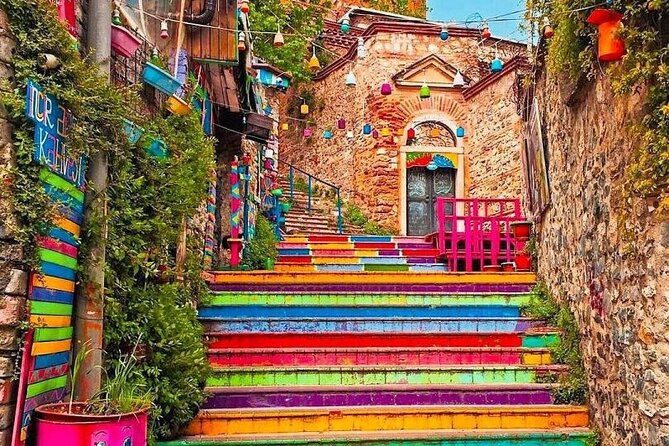
Now you turn toward Balat, where the atmosphere changes. This is where the tour starts to feel like a neighborhood walk, not a monument checklist.
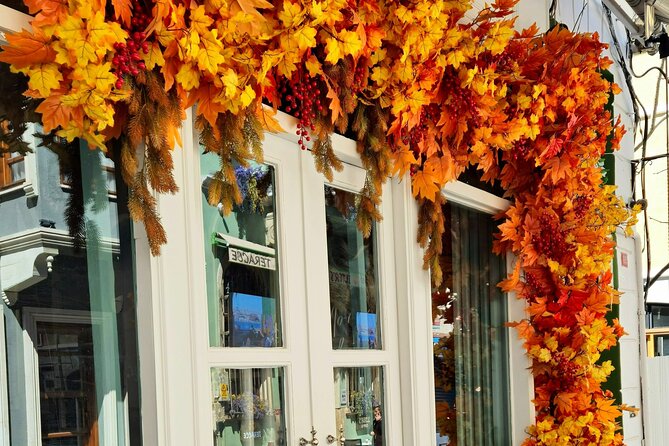
You visit Balat Colored Stairs (about 15 minutes). From there you move to Colorful Stairs for about 20 minutes. These stair stops are useful because Balat is built for perspective. Streets go up, homes stack closely, and colors show up in tight angles.
Balat is famous for cute cafes, colorful streets, and houses that carry a sense of history. But what makes it more than pretty visuals is the background:
- Balat has Byzantine heritage
- it was an old Jewish neighborhood and still has a large Jewish population
- the Sephardim, exiled from Spain in the 15th century, settled here
- the district is protected as a UNESCO World Heritage Site
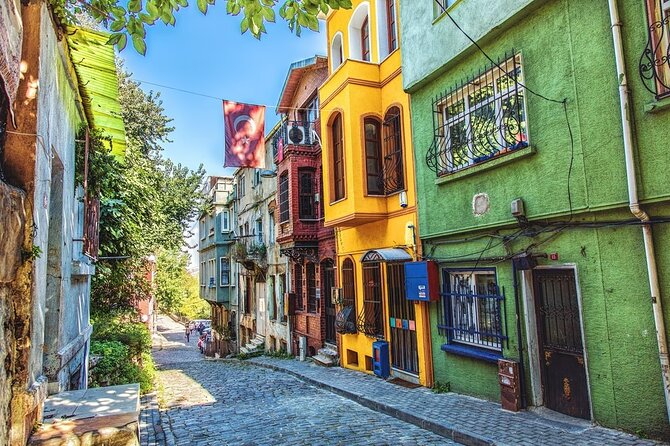
And here is one of the most practical “why the streets look like this” explanations you get: many houses were wooden before the 18th and 19th centuries, but fires damaged the area repeatedly. After that, masonry buildings became the preference. There are very few single-story buildings, and homes are often built in twos or threes.
That means when you walk, you are seeing the result of past disasters and rebuilding decisions. It is not random. It is planning shaped by survival.
If you are prone to rushing, slow down here. The stairs and tight lanes can make you want to move fast. But Balat rewards the opposite. Look at how the buildings sit next to each other, and how the street level changes your view.
Colorful houses and the story of fire, masonry, and compact living
This is the portion of the day where you benefit from having a guide. The “colorful stairs” are visually striking, but the meaning lives in the details of the built environment.
You get time for the Colorful Stairs area and also additional viewpoints in Balat. The tour approach helps you make sense of:
- the shift from wooden structures to masonry after fires
- why so many homes are clustered rather than spread out
- how the neighborhood layout supports dense, walkable living
This is where your camera will roll fast. But you will enjoy it more if you take a few minutes to look without photographing. Focus on building materials and the way roofs and facades line up. Those are your clues to the past.
Also, since some houses have been restored, you will see “layers.” That can be confusing if you do not know what you are looking at. The best trick is to ask your guide for a quick mental framework, then keep observing with that framework in mind.
Saint Stephen’s Bulgarian Orthodox Church, also known as the Iron Church
In Balat, your next major architectural stop is Saint Stephen’s Bulgarian Orthodox Church, often called the Bulgarian Iron Church.
This church is famous for being made from prefabricated cast iron elements in a Neo-Byzantine style. It belongs to the Bulgarian Christian minority in the city.
You get about 25 minutes, which is a good window for an architectural stop like this. The Iron Church is not just about exterior looks. Cast iron elements make the building different in a way you can usually spot once you start paying attention to structure and details.
If you like places where design choices show cultural identity, this is a highlight. It is a reminder that Istanbul’s neighborhoods did not develop in isolation. Minority communities built institutions that reflected their own styles and needs.
Watching Istanbul from the Golden Horn estuary
After Balat’s stair and church details, you head to the Golden Horn viewpoint for about 20 minutes.
This stop is a view-and-comparison moment. You are looking at Istanbul in a wider way, including both the European and Anatolian sides from the estuary area.
I find this timing works well because by now you have street-level context. You know where you are and what you just saw. So the view is not random scenery. It becomes a map in motion.
If you want an extra little trick, use the ferry view memory to compare angles. The city will look slightly different depending on where you are standing and which shore you are facing.
Egyptian Bazaar ending: dessert tasting and a classic market finish
Your day closes at the Egyptian Bazaar, also known as one of Istanbul’s oldest bazaars. You spend about 30 minutes here.
The best practical part: you get a free tasting for Turkish dessert and drinks. That is a real payoff after a day of walking and looking. It also gives you an easy first step when you arrive, especially if you feel market overload.
Your tour also notes you will end at the Spicy Bazaar area. So think of the finish as a transition. You arrive with your guide, then you can decide how much browsing you want to do after the tasting.
One thing to keep in mind: bazaars can get crowded, and the pace can feel different from earlier in the tour. If you want souvenirs, have a quick plan. Know what you are shopping for before you get swept into the stalls.
Who this tour suits best, and when to skip it
This tour is best for you if:
- you want a guided route that combines major sights and neighborhood texture
- you like history you can see in buildings, not just read on a sign
- you value included admissions, ferry transport, and small food tastings
- you prefer a structured half-day around clear walking stops
It might be less ideal if:
- you hate stair-heavy routes, since Balat includes multiple stair sections
- you are on a strict budget and would rather pay for only the single tower separately
- you want a long, slow museum day, because the itinerary is built for movement and short focused visits
A final note based on what sticks with people about this style of tour: the day feels relaxed when your guide keeps your pace steady. Guides associated with this route, including Enru, have a reputation for being patient and adjusting smoothly to how you want to move through each stop.
Should you book this Galata to Balat route?
I’d book it if you want Istanbul in one compact story, from a skyline fire tower to Balat’s street-level layers, with a ferry view in the middle. The price makes sense because most admissions, church donations, ferry transport, and even dessert are included. The only meaningful extra cost is Galata Tower entry, so you can plan that and feel in control.
You should think twice if you dislike planning around an extra ticket or you want a longer time inside museums. This tour is not about lingering for hours. It is about getting oriented, seeing key places, and leaving with clear memories of neighborhoods, not just monuments.
If you like walking with structure and you want a guide who can keep the day smooth, this is a strong pick for a first-timer or anyone who wants a high-quality Istanbul sampler.
FAQ
Is the Galata Tower admission ticket included?
No. Galata Tower entry is not included. The rest of the listed stops include admission tickets.
How long is the tour?
The tour runs about 4 to 6 hours.
What language is the tour offered in?
It is offered in English.
Is transportation included?
Yes. Transportation by ferry is included, with a ferry stop around Karaköy Rihtim and viewpoints over the Golden Horn.
Is dessert included?
Yes. There is a free tasting for Turkish dessert and drinks, included in the Egyptian Bazaar stop.
Where does the tour start and end?
It starts at Tünel Meydanı Sokağı Şahkulu, Tünel Meydanı Sok., Beyoğlu. It ends at Egyptian Bazaar, Rüstem Paşa 34116 Fatih, and the tour notes you finish at Spicy Bazaar.
Balat Tours
- Istanbul: Fener Balat Half-day Guided Walking Tour★ 4.9 · 1,711 reviews
- Half day Fener-Balat Walking Tour in Turkiye★ 5.0 · 308 reviews
- Istanbul: Colorful Fener & Balat Walking Tour w/Expert Guide★ 4.7 · 234 reviews
- Istanbul: Fener, Balat, Old Greek and Jewish Quarter Tour★ 4.9 · 234 reviews
- Istanbul: Fener & Balat Guided Tour through Colored Streets★ 4.8 · 171 reviews
Newest tours in Istanbul

Galata Tower Guided Tours, compared.
Galata Tower All-Day Entry Ticket with Audio Guide
Read our review →
Istanbul City Walk: Galata Tower, Istiklal Street & Karaköy
Read our review →Istanbul City Walk: Galata Tower, Istiklal Street & Karaköy
Read our review →
Istanbul Combo: Dolmabahce Palace & Galata Tower
Read our review →
Multi Cultural Istanbul: Galata Tower – Fener and Balat – Golden Horn by Ferry
Read our review →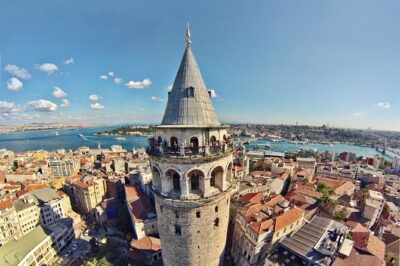
Galata Tower – Fener-Balat Neighborhoods & Golden Horn by Ferry
Read our review →Browse the lists this tour appears in